Showing posts with label theosophy. Show all posts

Monday, November 5, 2012

Hermetic Brotherhood of Light, the Hermetic Brotherhood of Luxor, the OTO and Chicago

There is a bit of confusion surrounding the Hermetic Brotherhood of Light.  What was it, and what was its connection to the Hermetic Brotherhood of Luxor?  Were they one and the same?  Many seem to be under the impression that they were, and it's an easy enough conclusion to jump to. 

There are rumors of a Hermetic Brotherhood of Light operating early enough for Paschal Beverly Randolph to have been a member, and persisting long enough to eventually transform into the OTO.  There are rumors that the highly influential Hermetic Brotherhood of Luxor had ties to Chicago.  The whole situation is quite confusing, and it doesn't make matters easier when considering that many of these organizations had habits that included claiming a lineage of over 4000 years, associating themselves with names of those long dead.

Here is what I have been able to determine.  Of course, I would love to hear from anyone with more information.

The Hermetic Brotherhood of Luxor was founded in 1870 and premiered publicly in 1884.  The H.B.L. was heavily inspired by the teachings of Paschal Beverly Randolph, though they later drew a bit of distance from him after deeming his suicide to be unsavory.  They also had a bit of a rivalry with the Theosophical Society - despite sharing many similar beliefs, approaches and even members, the two organizations had a bit of a public sparring match.

Despite rumors, I have yet to find any information linking the H.B.L. to Chicago.  The Theosophical Society was already firmly established here, and I have to wonder if they had a mutual understanding to keep their distance.  Still the influence of the Hermetic Brotherhood of Luxor was felt in Chicago, with several splinter groups arising here.

"Dr. W.P. Phelon and his wife, both of whom were prominent Theosophists and members of the H.B. of L., founded and ran the curiously named "Hermetic Brotherhood of Atlantis, Luxor and Elephantae," first in Chicago and then in San Francisco, and published a variety of "Hermetic Manuscripts" and a Hermetic Journal." -The Hermetic Brotherhood of Luxor, Initiatic and Historical Documents of an Order of Practical Occultism, Jocelyn Godwin, Christian Chanel and John P Deveny.

After moving to San Francisco, the Phelons apparently shortened their organization's name to simply "the Hermetic Brotherhood," with their publishing company being the "Hermetic Book Concern."  Their chosen symbolism is interesting in that it employs an ouroboros lifted directly from the Hermetic Brotherhood of Luxor, with a winged swastika, combining symbolism from both the H.B. of L. and the Theosophical Society.

Another organization following the H.B. of L. with links to Chicago was the Hermetic Brotherhood of Light:
"Finally, there was the Hermetic Brotherhood of Light, founded or reorganized in Chicago or in Boston in 1895, whose teachings fed the streams of sexual practice flowing into the Ordo Templi Orientis of Theodor Reuss and eventually into the works of Aleister Crowley." -The Hermetic Brotherhood of Luxor, Initiatic and Historical Documents of an Order of Practical Occultism, Jocelyn Godwin, Christian Chanel and John P Deveny.

Information regarding the Hermetic Brotherhood of Light is scarce.  Even authorities on the subject seem unsure as to its origins - was it a group inspired by the Hermetic Brotherhood of Luxor, or was it the other way around?  What is known is that the teachings of the Hermetic Brotherhood of Light went on to inspire, if not itself become, the Ordo Templi Orientis.

From the 1917 constitution of the OTO, by Theodor Reuss:
"While numberless societies, associations, orders, groups, etc., have been founded during the last thirty years in all parts of the civilised world, all following some line of occult study, yet there is but ONE ancient organization of genuine Mystics which shows to the seeker after truth a Royal Road to discover the Lost Mysteries of Antiquity and to the Unveiling of the One Hermetic Truth.
This organization is known at the present time as the:
Ancient Order of Oriental Templars
Ordo Templi Orientis
Otherwise: The Hermetic Brotherhood of Light."

 Did a Chicago organization have a hand in the eventual organization of the OTO?  Perhaps it shouldn't be too surprising, considering the fact that both Aleister Crowley and Charles Stansfeld Jones (Frater Achad) lived here at one point.

Thursday, August 2, 2012

Steinway Hall

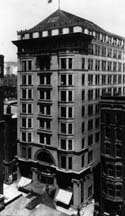
Built in 1896, Steinway Hall was located at 64 E Van Buren St.  The building went through a variety of name changes over the years and also housed a number of activities of interest to readers here.

Image courtesy the Steinway Hall Wikipedia page.

In its early days, the 11-story office building housed a number of architects, including Frank Lloyd Wright (who remained in the building until 1908). During this time, Steinway Hall was briefly being advertised as a "Temple of Magic."

Image courtesy the Chicago Magic blog.  While focusing on stage magic, there is definitely information of interest.

Image of the theater during it's run as the "Punch and Judy Theater" courtesy the Cinema Treasures website.


The 850-seat theater in the building originally was a branch of Ziegfeld's theaters (while the Follies were taking off in New York, Flo Ziegfeld was originally from Chicago).  The theater was home to acts such as Sophie Tucker and Fatty Arbuckle.  In 1915 the theater's name was changed and Shakespearean plays were produced.

The same theater was rented out by the Theosophical Society, who secured every Sunday for a six month period of time.  During this time, Charles Leadbeater lectured on a variety of subjects relating to the occult and Theosophy.  Leadbeater, having just arrived from England, packed the theater to the extent that would-be listeners regularly had to be turned away at the door.  His lectures here in Chicago would be published as the book Some Glimpses of Occultism Ancient and Modern.

In 1941, after the schism of C.F. Russell's Choronzon Club, one of the splinter groups housed itself at Steinway Hall (practically around the corner from the Fine Arts Building where they had previously met).  They would remain here until the 1960s, when they would return to the Fine Arts Building.    For more information on this, please visit my previous post regarding C.F. Russell and the Fine Arts Building.

Around this time the theater was being used to show adult movies.  Public sentiment had swayed against the building, and it was demolished on April 5, 1970.  Apparently it was written in the Chicago Tribune that “Few, if any, will mourn it.”

In its place, we now have a parking lot.

Monday, July 30, 2012

William Walker Atkinson, the Kyballion and the Yogi Publication Society


I've been putting off posting about William Walker Atkinson due to the fact that there is such a wealth of information that I honestly don't know where to begin.  Simply put, Atkinson was a writer, publisher and major player in the New Thought Movement.  The full story is much more complicated than that.

Atkinson (1862 - 1932) worked in a variety of professions, settling into the role of lawyer while in Pennsylvania.  After a variety of ups and downs in his personal life, he disappeared for six weeks around the turn of the century with a renewed passion for life and interest in the occult.  At this point he immediately moved to Chicago and began writing articles under his own name and a variety of pseudonyms, including Theron Q. Dumont and Yogi Ramacharaka.

In Chicago he also founded the Yogi Publication Society, which was located in the  Masonic Temple building - the name sounded great for the publishing company, but there was actually no Masonic affiliation with the Yogi Publication Society.  The Masonic Temple was the city's first skyscraper - the Masons met on the top floors, the rest were rented to a variety of different businesses.

The Yogi Publication Society published the Kyballion, a book of Hermetic teachings which was compiled by "Three Initiates."  Shrouded in mystery, it is now accepted that Atkinson himself wrote this book.

The Chicago Examiner, in 1910, with an article introducing yoga to the general public via Atkinson's pseudonym, Yogi Ramacharaka (here spelled Ramachakra).

The Yogi Publication Society still exists, though their website leaves a bit to be desired. 

Luckily for us, Philip Deslippe has dedicated himself to unraveling the mysteries surround Atkinson's life and abundant literary output.  He has recently released a definitive edition of the Kyballion.

For an excellent interview with Deslippe regarding Atkinson, visit this podcast on Occult of Personality.  After you listen to that interview, listen to all of the remaining on the site, as they are all excellent.

Of note to those paying attention, Atkinson co-authored one book with infamous local L.W. de Laurence entitled Psychomancy and Crystal Gazing.

Thursday, May 17, 2012

Occult World Disclosed at Theosophist Meeting, 1902

Apparently Chicago was a popular place to hold national Theosophist conventions.  A few years later, Theosophists would meet at Stevens Hotel.  In 1902 they met at Steinway Hall, which was located at 64 East Van Buren street from 1896-1970. 

Chicago Daily Tribune, September 29 1902
 
I love how these things start tying together.  This is the same address that at least one of the offshoot groups of C.F. Russell's Choronzon Club met at from the 1940s through the 1960s.

Thursday, April 19, 2012

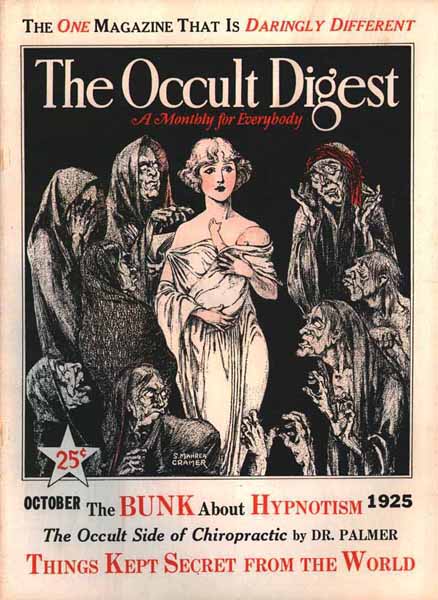
The Occult Digest

The Occult Digest - A Magazine for Everybody was a Chicago magazine published from 1925 until 1947.

It was published for quite some time in a great looking building known as the "Occult Digest Center," which also included the "Occult Book Mart."  This was located near what is now Lincoln Park (and coincidentally right around the corner from where Process Church and the Foundation Church of the Millennium would set up headquarters in the 1970s).  They also published Psychic Power magazine in the early 1920s and a variety of books on occult subjects.

This cover image blatantly stolen from the Jackie Gleason Archives at the University of Miami Libraries

As far as I can tell, the Occult Digest had amazing cover art for only the first couple of issues, then utilized a fairly generic (though decidedly Art Deco) cover design.  Please forgive these low quality snapshots.
By the early 1930s they switched to a more blocked off design.


Some subjects are obviously problematic now.  There are allusions to the fallout from the Civil War and the ideas regarding eugenics and race.


I love both of these articles about magic and music.


It was interesting for me to see several ads referring to psychic or clairvoyant phenomenon as "human radio."  It put some things into perspective regarding the things I've been reading about Radionics lately.  Imagine how crazy it must have seemed, sending sound through the air invisibly.  


The National Theosophical Convention was held in Chicago at the Stevens Hotel, which is now the Hilton.


Effa Danelsen was the driving force behind Occult Digest, appearing to edit and publish the magazine as well as writing for it. 

CF Russell wrote regularly for the magazine from 1930 - 1933.  Also, he regularly placed ads for his  Choronzon Club in Occult Digest.  His writings from this time have been archived online on this website.  Russell definitely deserves an entry all of his own here at some point.

By 1939 The Occult Digest merged with the Telepathic Magazine.  The format changed from a standard magazine size to a small digest with only 30 pages per issue.  At this point it was published by Maha Publishing, and the headquarters would move to south 89th street with new editor Marie Harlowe.  Much of the magazine seems to have revolved around Harlowe at this point, with her writing the editorial column and various articles relating to comparative religion.  Several pages were also dedicated to advertisements for Harlowe's "Occult Lessons" in "Breathing Methods Suitable to Western Vehicles."  In 1942 the magazine changed its name to World Philosophy.