Showing posts with label 1920s. Show all posts

Monday, July 30, 2012

William Walker Atkinson, the Kyballion and the Yogi Publication Society


I've been putting off posting about William Walker Atkinson due to the fact that there is such a wealth of information that I honestly don't know where to begin.  Simply put, Atkinson was a writer, publisher and major player in the New Thought Movement.  The full story is much more complicated than that.

Atkinson (1862 - 1932) worked in a variety of professions, settling into the role of lawyer while in Pennsylvania.  After a variety of ups and downs in his personal life, he disappeared for six weeks around the turn of the century with a renewed passion for life and interest in the occult.  At this point he immediately moved to Chicago and began writing articles under his own name and a variety of pseudonyms, including Theron Q. Dumont and Yogi Ramacharaka.

In Chicago he also founded the Yogi Publication Society, which was located in the  Masonic Temple building - the name sounded great for the publishing company, but there was actually no Masonic affiliation with the Yogi Publication Society.  The Masonic Temple was the city's first skyscraper - the Masons met on the top floors, the rest were rented to a variety of different businesses.

The Yogi Publication Society published the Kyballion, a book of Hermetic teachings which was compiled by "Three Initiates."  Shrouded in mystery, it is now accepted that Atkinson himself wrote this book.

The Chicago Examiner, in 1910, with an article introducing yoga to the general public via Atkinson's pseudonym, Yogi Ramacharaka (here spelled Ramachakra).

The Yogi Publication Society still exists, though their website leaves a bit to be desired. 

Luckily for us, Philip Deslippe has dedicated himself to unraveling the mysteries surround Atkinson's life and abundant literary output.  He has recently released a definitive edition of the Kyballion.

For an excellent interview with Deslippe regarding Atkinson, visit this podcast on Occult of Personality.  After you listen to that interview, listen to all of the remaining on the site, as they are all excellent.

Of note to those paying attention, Atkinson co-authored one book with infamous local L.W. de Laurence entitled Psychomancy and Crystal Gazing.

Thursday, July 12, 2012

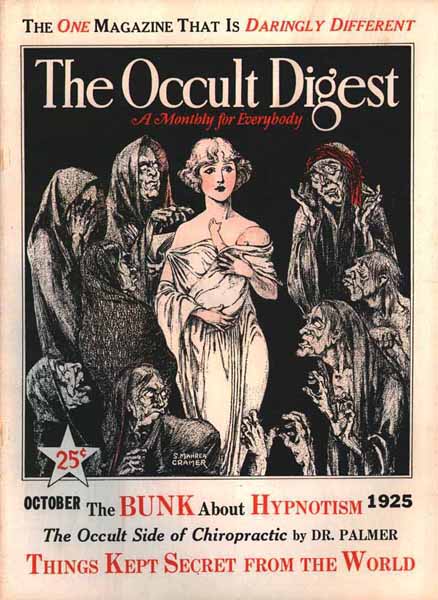
Occult Digest covers

Lucky for us, Tumblr user onanhero has scanned many of those early, hard to find painted Occult Digest covers.

Many more on the original post here:
http://onanhero.tumblr.com/post/15646669281/covers-from-9-of-the-first-10-issues-of-occult

Thank you for sharing these, onanhero!

Saturday, May 26, 2012

Towertown, sexuality and the occult in Chicago at the turn of the century

Today I spent a bit of time poking around the Encyclopedia of Chicago, an interesting database provided via the Chicago History Museum.  I was interested to read about an area known as Towertown which I had never heard mention of before.  Doesn't this sound amazing?

"Neighborhood in the Near North Side Community Area. Towertown was Chicago's bohemia in the early twentieth century. Lacking precise boundaries, the district took its name from the Water Tower, which stood to its north and east on Michigan Avenue. An art colony took root in Towertown when Anna and Lambert Tree built Tree Studios to tempt artists to stay in Chicago after the 1893 World's Columbian Exposition. The concentration of artists, writers, and poets attracted bookshops and coffeehouses, the most famous of which was the Dill Pickle Club. Soapbox orators gathered in Bughouse Square to debate the issues of the day. Gays, lesbians, and experimenters in free love took refuge among Towertown's radicals. By the mid-1920s, rising property values driven by the luxury shopping district on nearby Michigan Avenue were pricing out many of the artists. Towertown became a tourist attraction, further alienating its bohemian denizens. By the Great Depression, the art colony had dispersed."
-Amanda Seligman

"By the mid-1920s, many of these writers had left Chicago. After their departure, according to sociologist Harvey W. Zorbaugh, Towertown became a popular destination for “egocentric poseurs, neurotics, rebels against the conventions of Main Street or the gossip of the foreign community, seekers of atmosphere, dabblers in the occult, dilettantes in the arts, or parties to drab lapses from a moral code which the city had not yet destroyed.” Chicago's bohemia turned conventional, and its alternatives to traditional gender roles, sexual relations, and work habits became part of a broader transformation in social mores."
-Timothy B. Spears

Wednesday, April 25, 2012

Psychic Power magazine

Psychic Power magazine was the forerunner of Occult Digest, being published in the earlier part of the 1920s.  Like the Digest, it was edited and published by Effa Danelson.  Psychic Power was just slightly different in that it had less illustrations and focused a bit more on Spiritualism, seances and etc.


A year's worth of Psychic Power, bound.


Local spirit photographer W.K. Dunmore published a series of essays in Psychic Power which would later be published in book form.


Dunmore also had ads featured in the back of the magazine.

The Psychic Power headquarters, later home to the Occult Digest and Occult Book Mart.

Documenting seances and other events at the center.


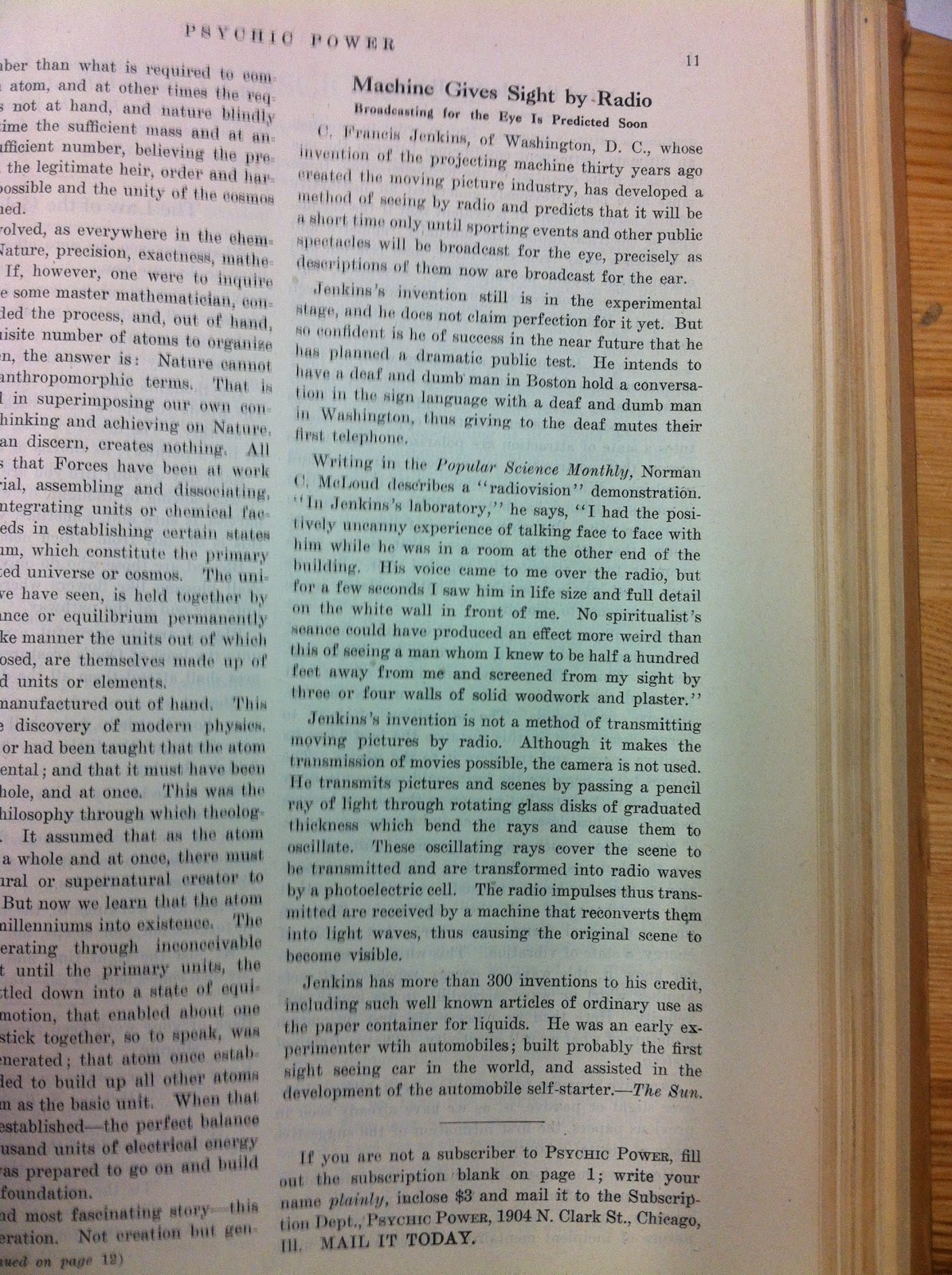
Two articles from the same year regarding radio gaining "sight."


I'd read before about Edison's secretive inventions intended to contact the deceased.  I appreciate finding this article published during his lifetime.


 Publisher and editor Effa Danelon


Tuesday, April 24, 2012

CF Russell, Sex Magick and Fine Arts

I mentioned CF Russell in my previous post regarding the Occult Digest, and promised that I would devote an entire post to him.  This is a fascinating subject in relation to Chicago's history, the history of the occult and the local gay community that worked in esoteric circles locally in the early 20th century.  Needless to say, someone could write an amazing essay/book/thesis on the subject.  This is my attempt to show the tip of the iceberg.


Cecil Frederick Russell (1897-1987) was at first an ardent follower of Aleister Crowley.  After getting dishonorably discharged from the US Navy, Russell stayed at Crowley's Abbey of Thelema briefly, where the two fought and parted ways.  Russell (who Crowley referred to as having a "violent reaction against any act of authority") then founded his own order, the Choronzon Club, in 1928. Some sources say that Crowley suggested that he The Choronzon Club changed its name to G.B.G. in 1931 - it is often believed stand for "Great Brotherhood of God," though apparently Russell was evasive regarding the meaning of the acronym. 


Dues were only $5, and if a new member got a friend to enroll then they were able to keep half of this amount.


Russell put out advertisements in the Occult Digest, which he also wrote several articles for:
A shortcut to Initiation
The Choronzon Club
Box Chicago, 111

Naturally there are those who disagree with any idea of "shortcut," so Russell raised some eyebrows with what some called "abbreviated rituals" (though they may have just been jealous of his quickly growing numbers due to the fast track and low dues).  "For his first few months of membership the initiate of the G.B.G. was kept in ignorance of its sexual-magical affiliations and were only revealed to him (or her) after he had satisfactorily completed a course of occult training devised by Russell" (Francis King, "Sexuality Magic & Perversion").  This course can be found online as a PDF very easily.

 "But in 1933 a schism broke out in Russell's ranks; a meeting was held
 on the 8th floor of 410 South Michigan Avenue in Chicago, with the
 object of forming a group consisting exclusively of homosexual men (the
 basis on which all contemporary XI° groups are founded). Eventually
 four groups could be distinguished as springing from Russell's initial
 foundation... 

"The remaining members in Chicago, who had been an exclusively XI° group for some time, had held their meetings at 64 East Van Buren Street since 1941 independently of Russell; in the 1960s they returned to Michigan Avenue."
(http://parareligion.ch/sunrise/xi.htm)

For those not aware, XI° was the anal sexual magick degree of Crowley's formulated for the O.T.O.  

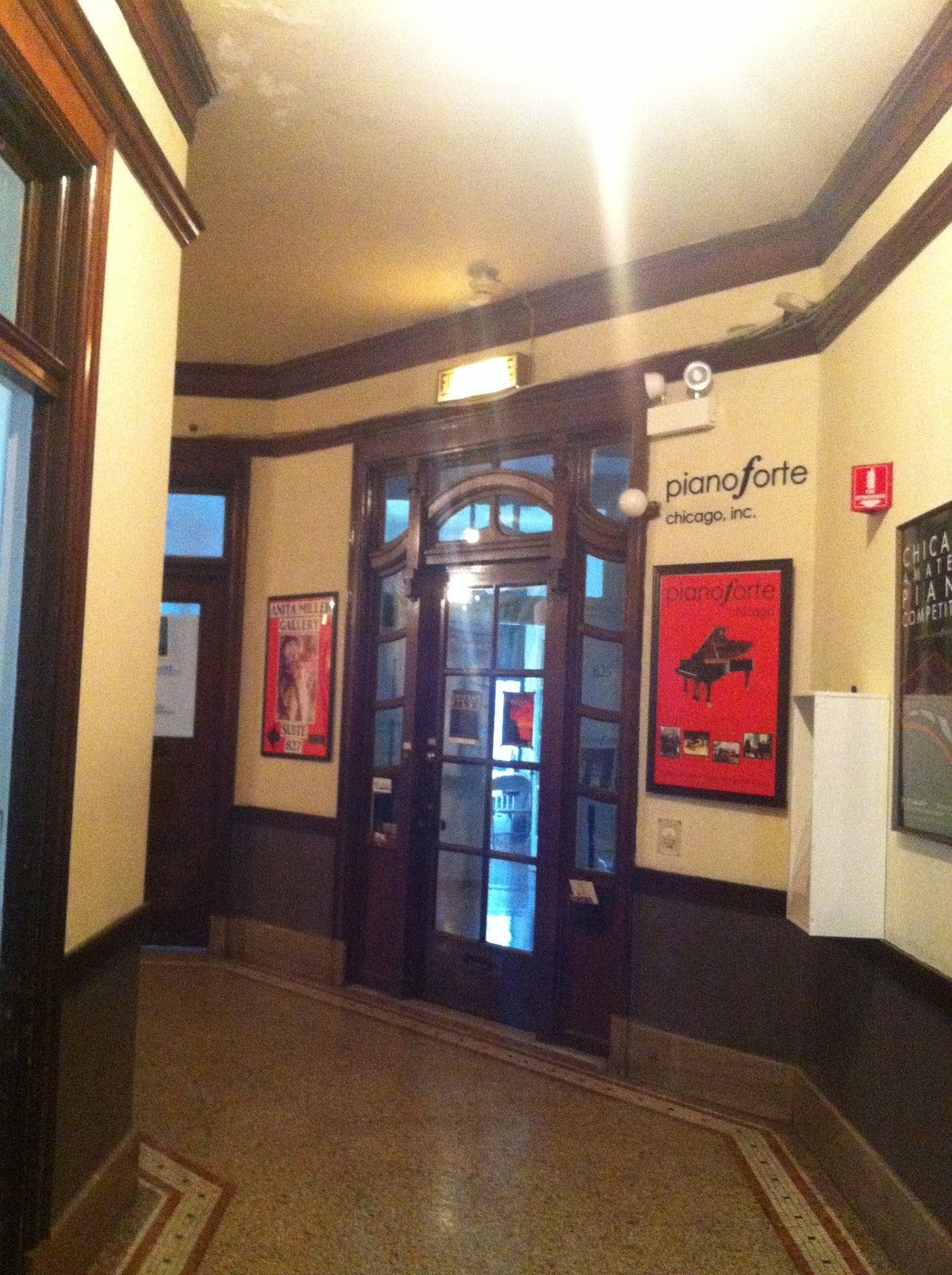
Those of you who are paying attention will recognize the 410 South Michigan Avenue address as being the Fine Arts building.  The building how houses artist studios, several music instructors, a Kundalini Yoga studio and others.  There is an art walk on the 2nd Friday of every month.  The building was built in 1885 and at one point housed a number of Theosophical groups, among other things.  If you wander through the building, it's easy to feel some of the earlier roots.

entrance

Prepare for an obligatory elevator ride with a human elevator operator.

 Murals on the top (10th) floor.


 staircase finials

8th floor, as mentioned previously

also on the 8th floor


Selected Works bookstore on the 2nd floor - these are only the discount books outside of the entrance.  They have a cat that roams the stacks, and if you look you can find books that were originally part of different Theosophical / esoteric groups.

Many of Russell's writings can be found online here:  http://cfrussell.homestead.com/files/intro.htm

All of the information in this post taken from:
1.  XI°: Anal Intercourse and the Ordo Templi Orientis - http://parareligion.ch/sunrise/xi.htm
2. Sexuality, Magic & Perversion, Francis King
3. Magick - The Order of the GBG (online PDF)


Thursday, April 19, 2012

The Occult Digest

The Occult Digest - A Magazine for Everybody was a Chicago magazine published from 1925 until 1947.

It was published for quite some time in a great looking building known as the "Occult Digest Center," which also included the "Occult Book Mart."  This was located near what is now Lincoln Park (and coincidentally right around the corner from where Process Church and the Foundation Church of the Millennium would set up headquarters in the 1970s).  They also published Psychic Power magazine in the early 1920s and a variety of books on occult subjects.

This cover image blatantly stolen from the Jackie Gleason Archives at the University of Miami Libraries

As far as I can tell, the Occult Digest had amazing cover art for only the first couple of issues, then utilized a fairly generic (though decidedly Art Deco) cover design.  Please forgive these low quality snapshots.
By the early 1930s they switched to a more blocked off design.


Some subjects are obviously problematic now.  There are allusions to the fallout from the Civil War and the ideas regarding eugenics and race.


I love both of these articles about magic and music.


It was interesting for me to see several ads referring to psychic or clairvoyant phenomenon as "human radio."  It put some things into perspective regarding the things I've been reading about Radionics lately.  Imagine how crazy it must have seemed, sending sound through the air invisibly.  


The National Theosophical Convention was held in Chicago at the Stevens Hotel, which is now the Hilton.


Effa Danelsen was the driving force behind Occult Digest, appearing to edit and publish the magazine as well as writing for it. 

CF Russell wrote regularly for the magazine from 1930 - 1933.  Also, he regularly placed ads for his  Choronzon Club in Occult Digest.  His writings from this time have been archived online on this website.  Russell definitely deserves an entry all of his own here at some point.

By 1939 The Occult Digest merged with the Telepathic Magazine.  The format changed from a standard magazine size to a small digest with only 30 pages per issue.  At this point it was published by Maha Publishing, and the headquarters would move to south 89th street with new editor Marie Harlowe.  Much of the magazine seems to have revolved around Harlowe at this point, with her writing the editorial column and various articles relating to comparative religion.  Several pages were also dedicated to advertisements for Harlowe's "Occult Lessons" in "Breathing Methods Suitable to Western Vehicles."  In 1942 the magazine changed its name to World Philosophy.