Showing posts with label 1900s. Show all posts

Thursday, August 2, 2012

The Nature of Ghosts and the Human Spirit

Speaking of Leadbeater, he's mentioned in this offer to make some cash in exchange for proving that ghosts exist.  Take a look at this wonderful artwork!

Chicago Examiner, 1908

And for even more amazing artwork...  "After You Are Dead."


Also from the Chicago Examiner, 1908. 

Steinway Hall

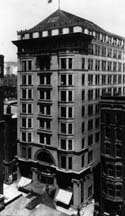
Built in 1896, Steinway Hall was located at 64 E Van Buren St.  The building went through a variety of name changes over the years and also housed a number of activities of interest to readers here.

Image courtesy the Steinway Hall Wikipedia page.

In its early days, the 11-story office building housed a number of architects, including Frank Lloyd Wright (who remained in the building until 1908). During this time, Steinway Hall was briefly being advertised as a "Temple of Magic."

Image courtesy the Chicago Magic blog.  While focusing on stage magic, there is definitely information of interest.

Image of the theater during it's run as the "Punch and Judy Theater" courtesy the Cinema Treasures website.


The 850-seat theater in the building originally was a branch of Ziegfeld's theaters (while the Follies were taking off in New York, Flo Ziegfeld was originally from Chicago).  The theater was home to acts such as Sophie Tucker and Fatty Arbuckle.  In 1915 the theater's name was changed and Shakespearean plays were produced.

The same theater was rented out by the Theosophical Society, who secured every Sunday for a six month period of time.  During this time, Charles Leadbeater lectured on a variety of subjects relating to the occult and Theosophy.  Leadbeater, having just arrived from England, packed the theater to the extent that would-be listeners regularly had to be turned away at the door.  His lectures here in Chicago would be published as the book Some Glimpses of Occultism Ancient and Modern.

In 1941, after the schism of C.F. Russell's Choronzon Club, one of the splinter groups housed itself at Steinway Hall (practically around the corner from the Fine Arts Building where they had previously met).  They would remain here until the 1960s, when they would return to the Fine Arts Building.    For more information on this, please visit my previous post regarding C.F. Russell and the Fine Arts Building.

Around this time the theater was being used to show adult movies.  Public sentiment had swayed against the building, and it was demolished on April 5, 1970.  Apparently it was written in the Chicago Tribune that “Few, if any, will mourn it.”

In its place, we now have a parking lot.

Monday, July 30, 2012

William Walker Atkinson, the Kyballion and the Yogi Publication Society


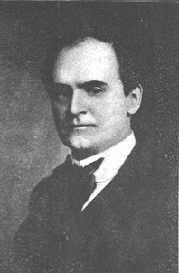
I've been putting off posting about William Walker Atkinson due to the fact that there is such a wealth of information that I honestly don't know where to begin.  Simply put, Atkinson was a writer, publisher and major player in the New Thought Movement.  The full story is much more complicated than that.

Atkinson (1862 - 1932) worked in a variety of professions, settling into the role of lawyer while in Pennsylvania.  After a variety of ups and downs in his personal life, he disappeared for six weeks around the turn of the century with a renewed passion for life and interest in the occult.  At this point he immediately moved to Chicago and began writing articles under his own name and a variety of pseudonyms, including Theron Q. Dumont and Yogi Ramacharaka.

In Chicago he also founded the Yogi Publication Society, which was located in the  Masonic Temple building - the name sounded great for the publishing company, but there was actually no Masonic affiliation with the Yogi Publication Society.  The Masonic Temple was the city's first skyscraper - the Masons met on the top floors, the rest were rented to a variety of different businesses.

The Yogi Publication Society published the Kyballion, a book of Hermetic teachings which was compiled by "Three Initiates."  Shrouded in mystery, it is now accepted that Atkinson himself wrote this book.

The Chicago Examiner, in 1910, with an article introducing yoga to the general public via Atkinson's pseudonym, Yogi Ramacharaka (here spelled Ramachakra).

The Yogi Publication Society still exists, though their website leaves a bit to be desired. 

Luckily for us, Philip Deslippe has dedicated himself to unraveling the mysteries surround Atkinson's life and abundant literary output.  He has recently released a definitive edition of the Kyballion.

For an excellent interview with Deslippe regarding Atkinson, visit this podcast on Occult of Personality.  After you listen to that interview, listen to all of the remaining on the site, as they are all excellent.

Of note to those paying attention, Atkinson co-authored one book with infamous local L.W. de Laurence entitled Psychomancy and Crystal Gazing.

Wednesday, June 20, 2012

The Bangs Sisters - Chicago's spiritualist portrait painters

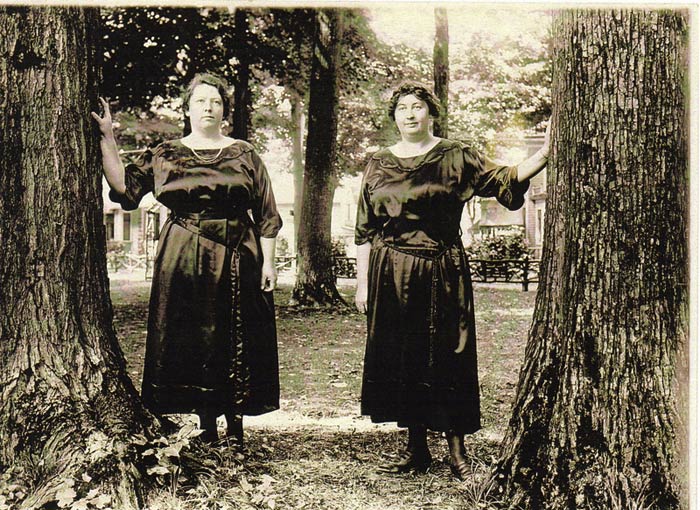
Mary "May" Bangs (born 1864) and Elizabeth "Lizzie" Snow Bangs (born in 1860) were mediums, getting publicity for contacting the dead at a very early age, with written reports of their seances dating at least as early as 1872.  Eventually the duo would become famous for materializing painted portraits of the dead.


The pair gained quite a following, with patrons regularly attending seances at their home in Chicago.  They also were the subject of numerous venomous newspaper articles and police raids - in 1888 one raid resulted in the death of Lizzie's 7 year old daughter.  After this incident, the sisters released this card:


Even marriage was scandalous for the Bangs sisters.


There was a lot of speculation regarding the method employed in the creation of the portraits of the dead.  Many believed that they were painted over enlarged photographs and/or painted by students hired from the Art Institute.

Video showing many of the Bangs Sisters' "precipitated" portraits, with some notes about the supernatural nature of the paintings themselves.


Saturday, May 26, 2012

Towertown, sexuality and the occult in Chicago at the turn of the century

Today I spent a bit of time poking around the Encyclopedia of Chicago, an interesting database provided via the Chicago History Museum.  I was interested to read about an area known as Towertown which I had never heard mention of before.  Doesn't this sound amazing?

"Neighborhood in the Near North Side Community Area. Towertown was Chicago's bohemia in the early twentieth century. Lacking precise boundaries, the district took its name from the Water Tower, which stood to its north and east on Michigan Avenue. An art colony took root in Towertown when Anna and Lambert Tree built Tree Studios to tempt artists to stay in Chicago after the 1893 World's Columbian Exposition. The concentration of artists, writers, and poets attracted bookshops and coffeehouses, the most famous of which was the Dill Pickle Club. Soapbox orators gathered in Bughouse Square to debate the issues of the day. Gays, lesbians, and experimenters in free love took refuge among Towertown's radicals. By the mid-1920s, rising property values driven by the luxury shopping district on nearby Michigan Avenue were pricing out many of the artists. Towertown became a tourist attraction, further alienating its bohemian denizens. By the Great Depression, the art colony had dispersed."
-Amanda Seligman

"By the mid-1920s, many of these writers had left Chicago. After their departure, according to sociologist Harvey W. Zorbaugh, Towertown became a popular destination for “egocentric poseurs, neurotics, rebels against the conventions of Main Street or the gossip of the foreign community, seekers of atmosphere, dabblers in the occult, dilettantes in the arts, or parties to drab lapses from a moral code which the city had not yet destroyed.” Chicago's bohemia turned conventional, and its alternatives to traditional gender roles, sexual relations, and work habits became part of a broader transformation in social mores."
-Timothy B. Spears

Thursday, May 17, 2012

Occult World Disclosed at Theosophist Meeting, 1902

Apparently Chicago was a popular place to hold national Theosophist conventions.  A few years later, Theosophists would meet at Stevens Hotel.  In 1902 they met at Steinway Hall, which was located at 64 East Van Buren street from 1896-1970. 

Chicago Daily Tribune, September 29 1902
 
I love how these things start tying together.  This is the same address that at least one of the offshoot groups of C.F. Russell's Choronzon Club met at from the 1940s through the 1960s.